
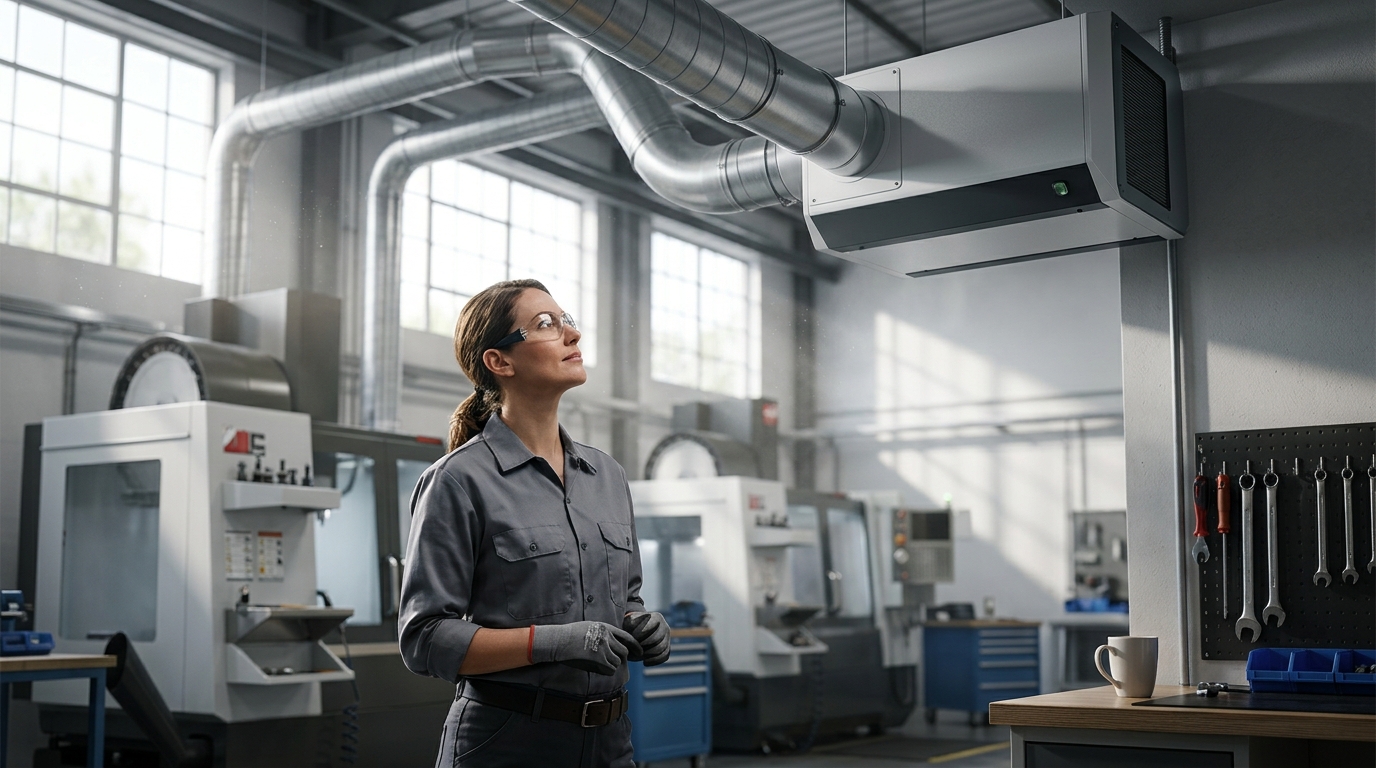
Top Industrial Air Filtration Solutions for Factory Worker Safety
Industrial air filtration is the process of removing airborne contaminants such as oil mist, coolant mist, and smoke from factory environments. Aeroex provides specialized filtration systems designed to capture these pollutants at the source, ensuring a safer and healthier workplace for manufacturing staff. This guide covers the top industrial air filtration solutions for factories, focusing on mist collectors, HEPA filtration, and wet scrubbers. We will explain how to select the right technology for your specific machine shop, production line, or controlled environment to maximize worker safety and operational efficiency.
Mist Collectors for CNC and Metalworking
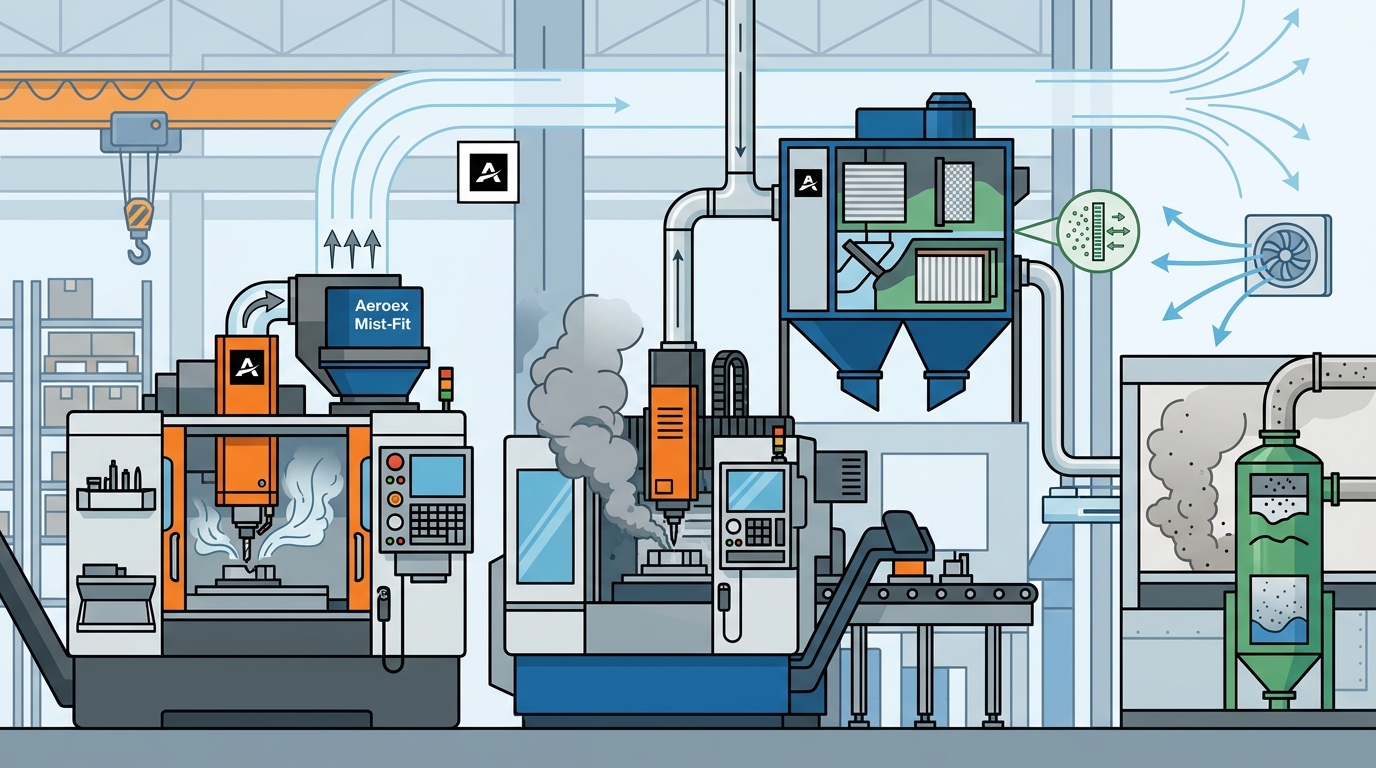
Mist collectors are the primary defense against airborne oil and coolant particles generated during machining. A mist collector is a machine-mounted or floor-standing unit that captures liquid droplets and submicron particulates before they enter the shop air. In CNC environments, these systems are critical for preventing tool degradation and protecting operator respiratory health. Aeroex designs these units to handle the specific chemistry of straight oil, soluble emulsions, and synthetic coolants.
Direct-Mount Solutions for Compact Spaces
Modular Systems for Complex Applications
When dealing with multiple machines or higher airflow requirements, a modular platform provides greater flexibility. The ARO-X series serves as a scalable filtration platform capable of handling mist, smoke, and fumes in a single engineered system. This solution is suitable for facilities that need to manage complex air quality challenges across a larger production floor. It allows for multi-stage filtration configurations that can be tailored to specific static pressure and airflow specifications.
HEPA Filtration for Critical Air Quality
HEPA filtration is a high-efficiency filtration standard that captures at least 99.97% of particles at 0.3 microns. In industrial settings, HEPA filters serve as the final stage of purification, ensuring that the air exhausted back into the facility is clean and safe. Aeroex integrates HEPA technology into its cleanroom and inspection area solutions to maintain strict air quality standards. This level of filtration is essential for environments where even trace particulates can compromise product integrity or worker safety.
Cleanroom and Inspection Area Applications
For facilities requiring controlled environments, such as pharmaceutical manufacturing or precision inspection labs, HEPA-filtered airflow is non-negotiable. The Air-Fit fan filter units deliver HEPA-filtered air with 99.99% efficiency at 0.3 microns. These units are designed for ceiling mounting and can create both positively and negatively pressurized environments. This capability allows facilities to maintain sterile conditions by precisely controlling airflow direction and pressure differentials.
Multi-Stage Filtration Architecture
Effective HEPA filtration relies on a multi-stage approach. Pre-filters and coalescers capture the bulk of liquid droplets and large particulates, protecting the HEPA media from saturation. This staged architecture extends the service life of the expensive HEPA filters and reduces overall maintenance costs. By capturing the heavy load in the initial stages, the HEPA filter focuses on removing the submicron fraction, ensuring consistent performance over time.
Wet Scrubbers for High-Volume Contaminants
Wet scrubbers are industrial air cleaning devices that use liquid to remove particulates and gases from exhaust streams. While Aeroex specializes in dry filtration and mist collection, understanding wet scrubbers is important for comparing technologies. Wet scrubbers are often used in applications involving high volumes of corrosive gases or very fine particulates that dry filters may struggle to capture. They work by forcing the contaminated air into contact with a liquid, which absorbs or traps the pollutants.
Comparison of Filtration Technologies
Selecting between dry mist collectors and wet scrubbers depends on the specific contaminants and facility constraints. The table below summarizes the key differences between these two primary industrial air filtration approaches.
| Feature | Dry Mist Collectors | Wet Scrubbers |
|---|---|---|
| Primary Mechanism | Filtration and Coalescence | Liquid Absorption and Impaction |
| Maintenance | Filter Replacement | Liquid Management and Disposal |
| Best For | Oil Mist, Coolant Mist, Smoke | Corrosive Gases, High-Volume Particulates |
| Footprint | Compact, Machine-Mounted | Larger, Requires Liquid Handling |
| Waste Stream | Solid Filters | Contaminated Liquid |
For most metalworking and CNC applications, dry mist collectors offer a simpler maintenance profile and lower operational complexity. However, for specific chemical processing or high-temperature fume applications, a wet scrubber might be the recommended engineering solution. Aeroex can help evaluate your specific process to determine if a dry or wet approach is most suitable for your facility.
How to Choose the Right System
Choosing the right industrial air filtration system requires a detailed assessment of your facility's unique conditions. There is no one-size-fits-all solution in industrial air quality. The correct choice depends on the type of machine, the coolant or oil used, and the physical layout of your shop floor. Aeroex works with clients to review these factors and recommend a configuration that meets their specific safety and operational goals.
Assessing Machine Type and Coolant Chemistry
The first step is identifying the source of the contamination. Different coolants produce different types of mist. Straight oil produces heavier droplets, while synthetic coolants may generate finer mists and odors. Understanding this chemistry helps determine the necessary filtration stages. For example, an optional carbon stage may be added to handle odors from synthetic coolant breakdown. This ensures that the system addresses both particulate and gaseous contaminants effectively.
Evaluating Airflow and Mounting Constraints
Airflow requirements dictate the size and power of the filtration unit. You must calculate the volume of air that needs to be processed to maintain safe concentrations. Additionally, mounting constraints play a significant role in the selection process. If floor space is limited, a direct-mount solution like the Mist-Fit is often the best fit. If you have multiple machines in a row, a larger modular unit like the ARO-X may be more efficient. Reviewing your machine enclosure design and existing ductwork is crucial for a successful installation.
Key Takeaways
- Mist collectors are essential for capturing oil and coolant mist at the source in CNC and metalworking environments.
- HEPA filtration provides 99.97% or higher efficiency, making it ideal for cleanrooms and critical inspection areas.
- Direct-mount collectors like the Mist-Fit are perfect for compact layouts where floor space is limited.
- Modular systems like the ARO-X offer scalability for facilities with multiple machines or complex airflow needs.
- Wet scrubbers are an alternative for high-volume corrosive gas removal but require liquid waste management.
- Choosing the right system depends on coolant chemistry, machine type, and facility layout.
- Aeroex provides engineered solutions tailored to specific industrial air quality challenges.
Frequently Asked Questions
What is the best mist collector for CNC machining?
The best mist collector depends on your specific machine and space constraints. For compact CNC machines, a direct-mount unit like the Aeroex Mist-Fit is often ideal. For larger setups or multiple machines, a modular system like the ARO-X provides the necessary airflow and filtration capacity.
How do HEPA filters work in industrial settings?
HEPA filters use a dense mat of glass fibers to trap particles. In industrial settings, they are typically the final stage in a multi-stage system, capturing submicron particles that pre-filters miss. This ensures that the air returned to the facility is clean and safe for workers.
Can mist collectors handle both oil and coolant mist?
Yes, modern mist collectors are designed to handle both. The filtration media is engineered to coalesce liquid droplets from both straight oil and synthetic or soluble coolant emulsions. The system separates the liquid from the air stream, allowing it to be drained or recycled.
What is the difference between a mist collector and a dust collector?
A mist collector is designed to capture liquid droplets and fine particulates generated by machining processes. A dust collector is designed for dry particulates like wood or metal dust. Mist collectors often include coalescing stages that dust collectors do not, making them unsuitable for dry dust applications.
How often do I need to replace filters in a mist collector?
Filter replacement frequency depends on the volume of mist generated and the type of coolant used. With proper multi-stage filtration, primary filters may last several months, while HEPA filters can last up to three years in some applications. Regular monitoring of filter condition is recommended.
Do I need a wet scrubber for my factory?
Most metalworking and CNC facilities do not need a wet scrubber. Dry mist collectors are sufficient for handling oil and coolant mist. Wet scrubbers are typically reserved for applications involving high volumes of corrosive gases or specific chemical processes where dry filtration is less effective.
How can Aeroex help me choose the right system?
Aeroex offers application reviews where their engineering team analyzes your machine configuration, airflow needs, and operating conditions. They can recommend the appropriate product line, whether it is a direct-mount Mist-Fit, a modular ARO-X, or a custom engineered solution.
Conclusion
Improving worker safety and air quality in factories requires the right industrial air filtration solution. Whether you need a compact mist collector for a single CNC machine or a complex engineered system for a large production facility, the technology is available to meet your needs. Aeroex specializes in providing these tailored solutions, ensuring that your facility operates with clean, safe air. To find the right fit for your specific application, for a consultation and application review.